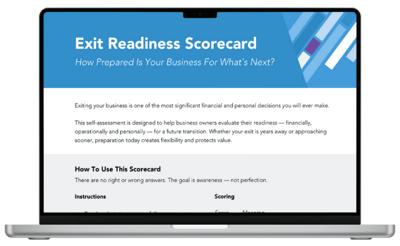
Many business owners assume they’ll figure out what their business is worth when they’re ready to sell or retire. In reality, waiting until the last minute often leads to surprises — and missed opportunities.
Understanding your business’s value isn’t just about selling. It’s about making smarter decisions today that protect what you’ve spent years building.
Here’s a straightforward guide to the basics every owner should know.
What Actually Drives the Value of a Business
While revenue and profits matter, they’re only part of the picture. Buyers and investors look at a combination of financial performance, risk and sustainability.
Some of the biggest value drivers include:
- Consistent, reliable earnings: Predictable performance is often more valuable than occasional spikes
-
Strong cash flow: Cash flow tells buyers how the business actually operates day to day
-
Customer and revenue diversification: Heavy reliance on one customer or contract can reduce value
-
Owner independence: Businesses that can operate without the owner’s daily involvement are typically more attractive
-
Clean financial reporting: Accurate, well-organized financials increase buyer confidence and reduce uncertainty
Value isn’t just about how much money the business makes — it’s about how dependable and transferable that income is.
Common Myths About EBITDA Multiples
One of the most common questions owners ask is “What multiple will my business sell for?“
While EBITDA multiples are often discussed, relying on them alone can be misleading.
Common myths include:
- “All businesses in my industry sell for the same multiple.”
- In reality, two similar businesses can sell for very different values based on risk, systems and growth potential
-
“A higher multiple automatically means a better business.”
-
Buyers pay higher multiples for lower risk — not just higher profits
-
-
“Online estimates or rules of thumb are close enough.”
-
These tools often ignore important factors that significantly impact value
-
Multiples are a result of valuation — not the starting point.
Why Internal Financials Aren’t Enough
Many owners rely on internally prepared financial statements to estimate value. While these reports are useful for running the business, they often don’t meet the standards buyers or lenders expect.
Potential issues include:
-
Inconsistent accounting methods
-
Personal or non-recurring expenses mixed into operations
-
Lack of documentation for owner add-backs
-
Limited historical trend analysis
Buyers want confidence that the numbers tell a clear, credible story. Reviewed or audited financial statements — along with professional business valuation — help remove doubt and reduce friction during due diligence.
When Should You Get a Formal Business Valuation?
A common misconception is that valuations are only needed right before a sale. In reality, the best time to get a valuation is years before you plan to exit.
A valuation can be helpful when:
-
You’re 5-10 years away from retirement
-
You want to understand how decisions today impact future value
-
You’re being approached by buyers or private equity firms
-
You’re planning for succession or ownership transition
-
You want a benchmark to measure progress over time
Think of a valuation as a planning tool — not a one-time event.
How a Valuation Helps Owners Make Better Decisions
A professional valuation doesn’t just provide a number. It helps owners:
-
Identify strengths and weaknesses that affect value
-
Prioritize improvements that offer the greatest return
-
Align tax and financial planning with long-term goals
-
Avoid rushed decisions under pressure
-
Enter negotiations informed and confident
Most importantly, it gives you control over timing, expectations and outcomes.
Final Thought: Knowledge Is Leverage
You don’t need to be ready to sell to benefit from understanding your business’s value. Knowing where you stand today allows you to plan intentionally, reduce risk and build options for the future.
A business valuation is often the first step toward a smoother, more successful transition — whenever that transition may be.
Need Help?
Every business owner’s path is different, and timelines can accelerate or slow based on opportunity, health, market conditions or personal goals. The earlier you understand where you are on the timeline, the more options you have.
Contact us here or call 800.899.4623.